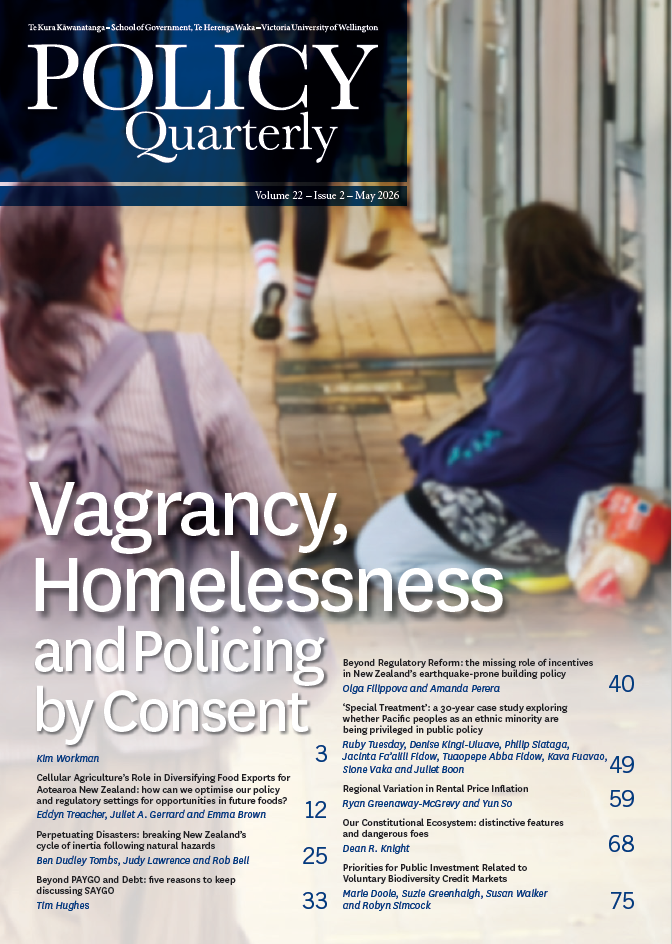
Vagrancy, Homelessness and Policing by Consent
DOI:
https://doi.org/10.26686/pq.v22i2.10720Keywords:
vagrancy, homelessness, move-on orders, coercive control, policing by consentAbstract
This article examines the historical and contemporary politics of vagrancy, homelessness and policing in Aotearoa New Zealand, arguing that current policy debates echo the punitive cultural attitudes of the late 19th century. Drawing on historical accounts of an ‘atomised’ colonial society marked by high levels of vagrancy and drunkenness, the article shows how early governments relied on imprisonment and coercive legislation to preserve an image of social cohesion and civility. It then traces the evolution of policing from coercive control to the 20th‑century model of ‘policing by consent’, grounded in public trust, discretion and community partnership. Under this model, homelessness was managed collaboratively between police and social agencies rather than through criminalisation.
Downloads
Downloads
Published
Issue
Section
License
Permission: In the interest of promoting debate and wider dissemination, the IGPS encourages use of all or part of the articles appearing in PQ, where there is no element of commercial gain. Appropriate acknowledgement of both author and source should be made in all cases. Please direct requests for permission to reprint articles from this publication to Policy-Quarterly@vuw.ac.nz.