
Introduction
DOI:
https://doi.org/10.26686/jnzs.v0i11.496Abstract
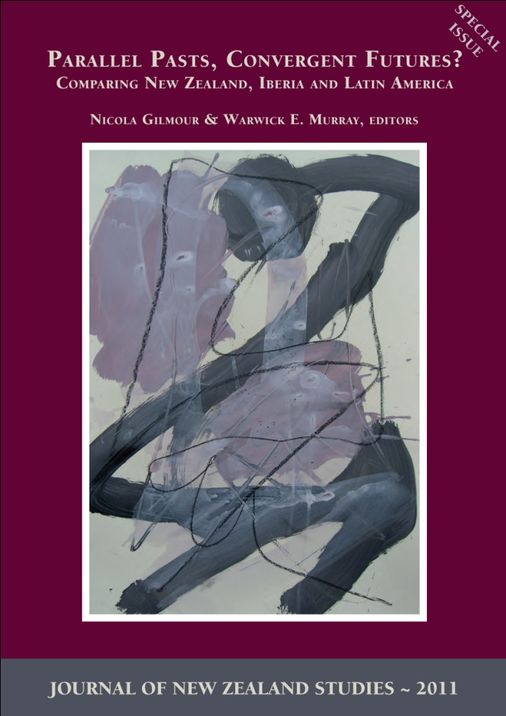
In September 2010, an exploratory conference that sought to examine contemporary and historical comparisons and connections between Latin America, Iberia and New Zealand took place at Victoria University of Wellington. Two of the country’s leading research institutes in their respective disciplines, the Stout Research Centre for New Zealand Studies, and the Victoria Institute for Links with Latin America, joined together to host a scholarly gathering that would, by incorporating academics from Victoria University’s Spanish and Brazilian Programmes, allow a broad comparative analysis of the three areas for the first time. James Belich, who had recently published a groundbreaking work on settler society in the Anglo-world, wondered what a comparison with the Hispanic settler societies might look like and, together with Richard Hill of the Stout Research Centre, suggested the exploration of such matters. The original remit expanded significantly and the eventual title of the conference was to become ‘Parallel Pasts, Convergent Futures? Comparing New Zealand, Iberia and Latin America’, a theme that would bring together speakers on topics as diverse as comparative cultural studies; historical political economy; politics of identity and nationalism; post-dictatorial society, memory and justice; and post-colonial developmental models, amongst others. Purposefully broad in its scope, the conference was underpinned by the desire to open new avenues of scholarly endeavour in order to investigate the conspicuously parallel historical evolution of the three regions and the even more striking potential for future convergence across an array of economic, political and cultural concerns.
The conference attracted speakers from many countries including, among others, New Zealand, Australia, Brazil, Spain, Chile and Argentina. Participants were asked to either undertake comparative analysis or to focus on connections between the three focus areas. What resulted was an interdisciplinary, historically and geographically diverse conference that brought to light a series of resemblances and disparities that had not been previously considered. This special edition of the Journal of New Zealand Studies publishes many of these analyses, focusing in particular, but not exclusively, on the comparative contributions that incorporate New Zealand. In what remains of this introduction, we first offer a concise context for the collection with an overview of comparisons and connections between Iberia, Latin America and New Zealand. Before some final thoughts, we go on to outline the three-part structure of the collection providing a summary of each of the contributions.
Downloads
Downloads
Published
Issue
Section
License
Authors who publish with this journal agree to the following terms:
The Journal of New Zealand Studies retains the copyright of material published in the journal, but permission to reproduce articles free of charge on other open access sites will not normally be withheld. Any such reproduction must be accompanied by an acknowledgement of initial publication in the Journal of New Zealand Studies.