
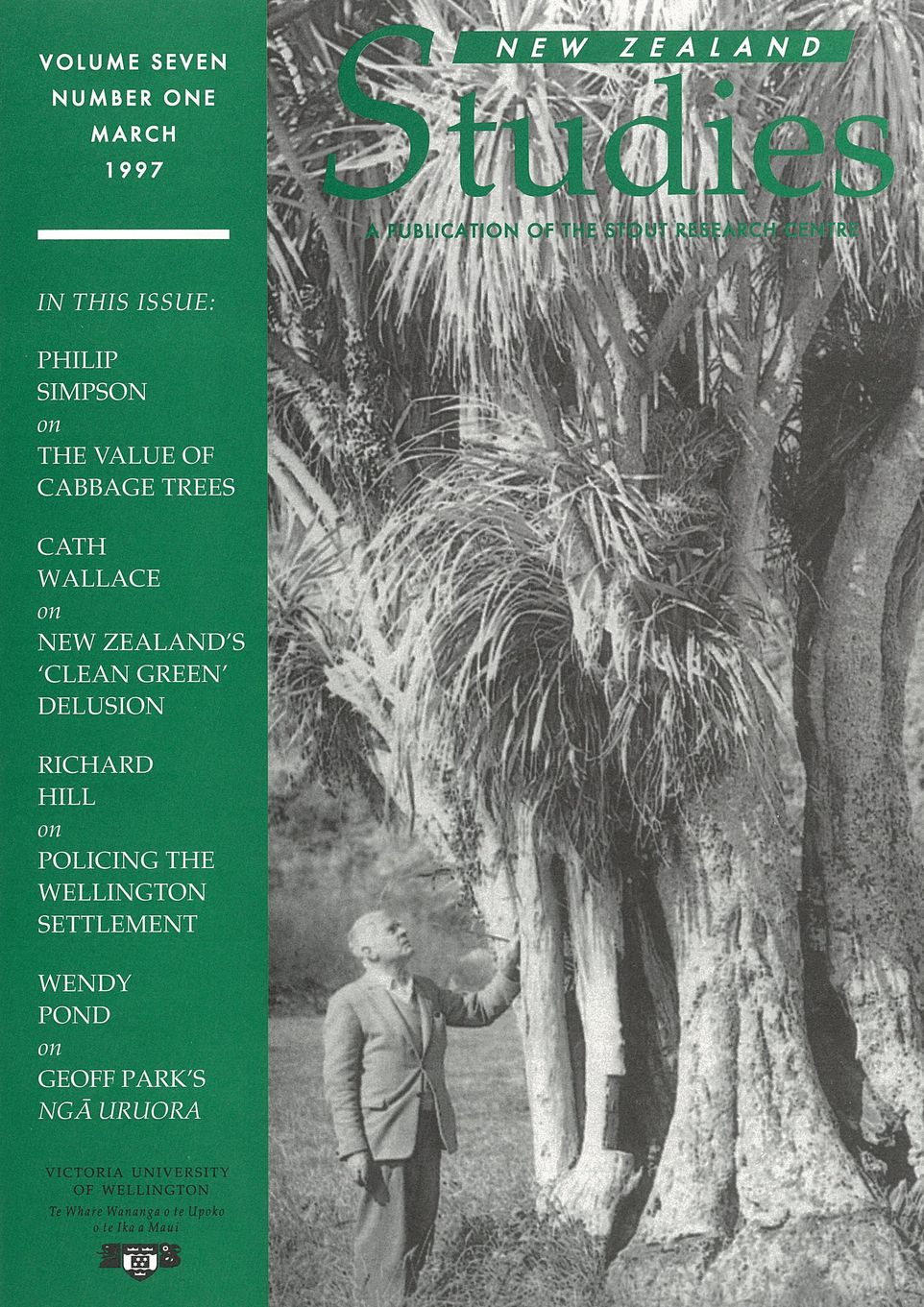
'The Control of Both Races': The Policing of the Wellington Settlement, 1840-1853
DOI:
https://doi.org/10.26686/jnzs.v7i1.394Abstract
In January 1843 two scandals rocked the Wellington settlement. Chief Police Magistrate Michael Murphy was forced to resign his position as Wellington's head of police. He had been accused, among other things, of cheating at cards in the exclusive Wakefield Club, which he almost certainly had not. At about the very same time his counterpart at the overflow settlement of Wanganui, Gilbert Dawson, was drummed out of his job too, on the basis of similarly dubious accusations that he had made homosexual advances to constables just before his own wedding. Neither men were angels, but other officials survived worse accusations.
Examining the real causes of these two scandals, which wrecked the careers of important state officials, will provide some clues as to the dynamics of a power struggle for the control of the new colony in its Dependency and early Crown Colony periods. The very significant role played by policing as a prerogative of the state will be highlighted. Three rival centres of power - the Crown, the New Zealand Company and Maori - vied with each other during an initial struggle. Out of that struggle the Crown emerged victorious, but in the process it modified its methodologies of social and racial control as a result of pressures from the other two centres of power.
Downloads
Downloads
Published
Issue
Section
License
Authors who publish with this journal agree to the following terms:
The Journal of New Zealand Studies retains the copyright of material published in the journal, but permission to reproduce articles free of charge on other open access sites will not normally be withheld. Any such reproduction must be accompanied by an acknowledgement of initial publication in the Journal of New Zealand Studies.