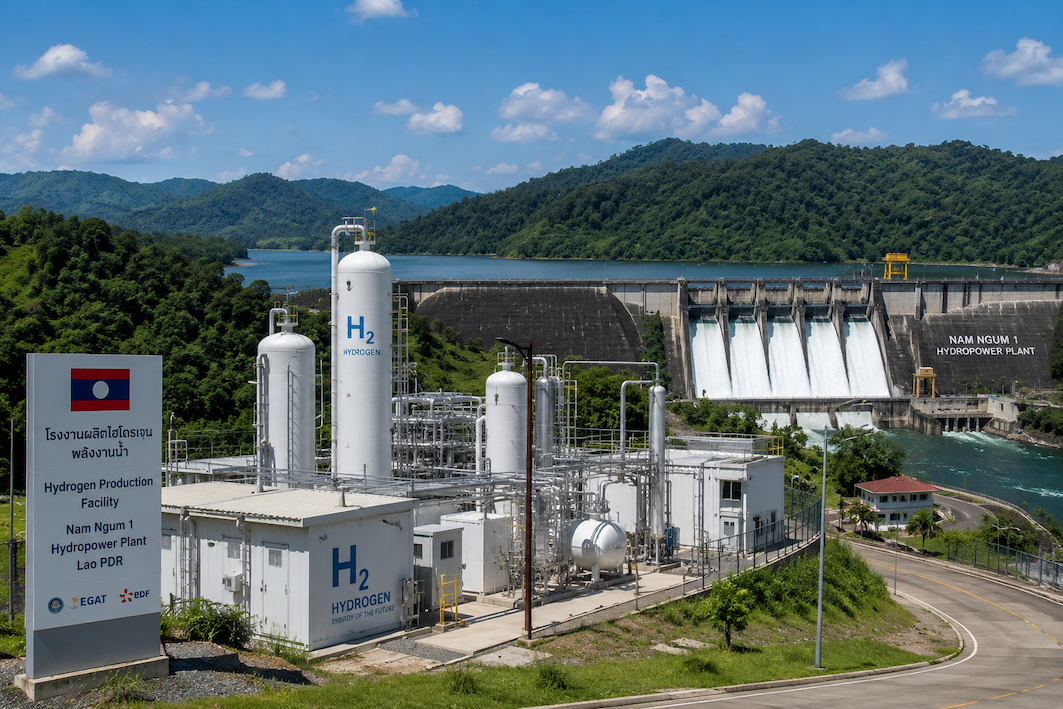
Techno-economic feasibility of green hydrogen as seasonal energy storage from surplus hydropower in Lao PDR
DOI:
https://doi.org/10.26686/ases.v2.11244Keywords:
Green hydrogen, Power-to-Hydrogen-to-Power, Seasonal energy storage, Techno-economic analysis, Lao PDRAbstract
Lao PDR faces a structural energy security challenge from the seasonal nature of its hydropower-dominated generation fleet. During the wet season (May to October), the country exports surplus electricity at approximately $0.05/kWh, yet imports approximately 1,765 GWh during the dry season at approximately $0.11/kWh from Thailand. This paper assesses the techno-economic feasibility of a Power-to-Hydrogen-to-Power (P2H2P) system as a seasonal storage solution to displace this import deficit. A five-step calculation model was applied using a 2.0 GW surplus hydropower cap, a 4,320-hour wet season production window, a 55 kWh/kg electrolyser energy requirement, and a 50% fuel cell efficiency, requiring 105,910 tonnes of hydrogen annually from a 1.35 GW electrolyser. Two hydrogen production cost scenarios, drawn from the Lao PDR National Green Hydrogen and Ammonia Roadmap, were assessed: an optimistic scenario of $1.24/kg at $10/MWh electricity, and a conservative scenario of $3.40/kg at $60/MWh. On a variable cost basis, the optimistic scenario yields $0.074/kWh, which is 33% below the $0.11/kWh import benchmark, while the conservative scenario yields $0.204/kWh, 85% above it. Once full system costs, including annualised fuel cell and seasonal hydrogen storage capital expenditure, are included, the Levelised Cost of Electricity rises to $0.117/kWh (optimistic) and $0.247/kWh (conservative), both above the import price. The findings show that while variable-cost hydrogen-stored electricity can be competitive with imports, the capital cost of seasonal storage infrastructure is the primary barrier to full system viability, identifying geological storage feasibility as the most urgent priority for future investigation.Downloads
Download data is not yet available.
Downloads
Additional Files
Published
2026-09-02
How to Cite
Sipaseuth, P., & Brent, A. C. (2026). Techno-economic feasibility of green hydrogen as seasonal energy storage from surplus hydropower in Lao PDR. Archives of Sustainable Energy Systems, 2. https://doi.org/10.26686/ases.v2.11244
Issue
Section
Articles
License
Copyright (c) 2026 Phonthana Sipaseuth, Alan Colin Brent

This work is licensed under a Creative Commons Attribution 4.0 International License.
The articles in the journal are published under the terms of the Creative Commons Attribution 4.0 International License (CC BY 4.0), which permits use, sharing, adaptation, distribution, and reproduction in any medium or format, provided the original author(s) and source are properly cited.