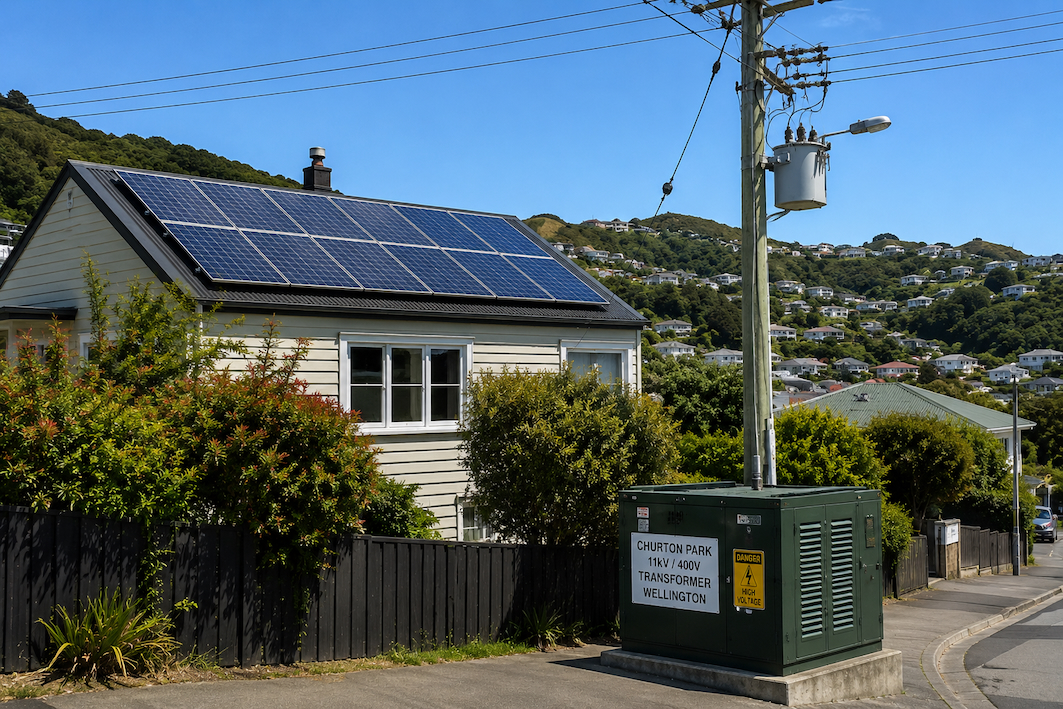
Reduce stress on local distribution transformers through load, battery control, and photovoltaics: A Wellington case study
DOI:
https://doi.org/10.26686/ases.v2.11235Keywords:
Distributed Energy resources, Photovoltaic systems, Battery energy storage systems, Electric vehicles, Low voltageAbstract
The growth of electric vehicles (EVs) and photovoltaic (PV) generation introduces new operational challenges for low voltage (LV) distribution networks, including transformer overloading, voltage deviations and bidirectional power flows. Mitigation measures often include the upgrading of conventional transformers and the re-conductoring of feeders. These methods become inefficient for uncertain load-growth paths. The technical effectiveness of coordinated distributed energy resources (DERs), such as rooftop PV systems, battery energy storage systems (BESS), and EV charging as non-wires alternatives (NWAs) to reduce the operational stress on local distribution transformers (LDTs) is assessed in this study. The representative Wellington suburban LV feeder is a 656-household feeder with 500-1000 kVA transformers. The feeder is modelled in DIgSILENT PowerFactory 2024 using the quasi-dynamic simulation language (QDSL) time-series at hourly resolution for one year. Four progressive scenarios are considered: (i) baseline operation without DERs, (ii) increasing PV penetration levels (5% in 2030, 10% in 2035, 28% in 2050), (iii) increasing number of EVs as load (5% in 2030, 10% in 2035, 28% in 2050) and (iv) integration of community-scale BESS for peak shaving. The results show that coordinated operation of DERs with BESSs can reduce transformer peak loading and improve voltage compared to standalone PV. In particular, the transformer-aware BESS dispatch offers a measurable peak shaving capacity and improves the local energy balancing, enabling a higher renewable penetration with less conventional infrastructure reinforcement. The practical role of DER coordination in improving LV network are more resilience and defers investment in the distribution systems as a scalable approach.Downloads
Download data is not yet available.
Downloads
Additional Files
Published
2026-09-02
How to Cite
Phengthavongsa, K., & Burmester, D. (2026). Reduce stress on local distribution transformers through load, battery control, and photovoltaics: A Wellington case study. Archives of Sustainable Energy Systems, 2. https://doi.org/10.26686/ases.v2.11235
Issue
Section
Articles
License
Copyright (c) 2026 Kittiphonh Phengthavongsa, Daniel Burmester

This work is licensed under a Creative Commons Attribution 4.0 International License.
The articles in the journal are published under the terms of the Creative Commons Attribution 4.0 International License (CC BY 4.0), which permits use, sharing, adaptation, distribution, and reproduction in any medium or format, provided the original author(s) and source are properly cited.